History of Albalat

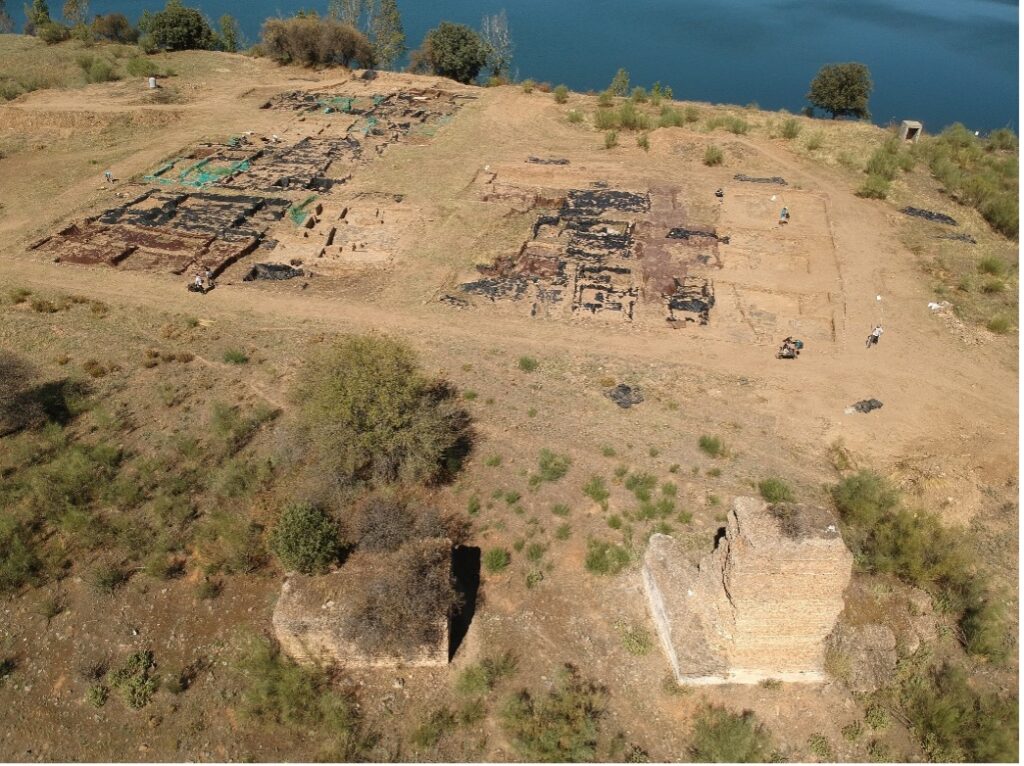
The archaeological site of Madīnat al-Balāṭ (Albalat), located in the municipality of Romangordo (Cáceres), is one of the most outstanding examples of an Andalusian-era fortified settlement in the rural areas of Extremadura. Its very name, meaning ‘the ford of the road’, evokes its main function: to control an ancient crossing of the Tagus river on the route connecting Mérida to Toledo.

Archaeological studies have shown that the site was occupied between the 9th and 12th centuries, coinciding with a period of intense political and military change. During the Caliphate of Córdoba and, subsequently, in the centuries of the taifas and the Almoravids, Albalat was consolidated as a fortified frontier outpost, designed to watch over the middle Tagus valley and to serve as a connection point between interior areas and routes to the Meseta.

Excavations begun in 2009 have uncovered a walled city with a complex urban fabric: cobbled streets, dwellings, craft workshops, public spaces and a bathhouse or hammam — elements showing an organised and active community.

Al-Balāṭ stands as a living testament to the Andalusian legacy in the heart of the Tagus Valley, a fundamental piece for understanding the medieval history of the region.

The archaeological site offers an exceptional glimpse into daily life in a small Andalusian town, revealing how its inhabitants utilized local resources, maintained trade relations, and adapted to a context marked by border instability. The discovery of ceramics, metal fragments, seeds, and animal bones has allowed for the reconstruction of part of this history, silenced for centuries.

In 2014, after years of research and conservation work, Al-Balāṭ was declared a Site of Cultural Interest (BIC) in the category of archaeological zone. This protection recognizes not only its historical and heritage value but also its potential as a space for learning about and disseminating the Islamic past of Extremadura.

Today, among the ruins of its walls and the traces of its streets, visitors can imagine a small border town that witnessed exchanges and tensions. Al-Balāṭ thus stands as a living testament to the Andalusian legacy in the heart of the Tagus Valley and as a fundamental piece for understanding the medieval history of the region.

9th Century
Foundation of the Andalusian settlement. Albalat emerges as a control point for the ford across the Tagus River on the Mérida–Toledo route.
10th – 11th Centuries
Consolidation during the Caliphate of Córdoba and the Taifa period. The city becomes a defensive hub on the frontier.
12th Century
Abandonment of the enclave coinciding with the advance of the Reconquista and the Almoravids. End of Islamic occupation.
2009
Start of systematic archaeological excavations under the direction of the University of Extremadura and the French CNRS.
2014
Declaration as an Asset of Cultural Interest (BIC) in the category of archaeological zone by the Junta de Extremadura.

Project volunteers

Since 2009, hundreds of people have volunteered for the excavation campaigns at Madīnat al-Balāṭ. Their work and dedication have made it possible to bring this Andalusian city to light.