
Projet scientifique
Systematic research on a 12th-century Islamic enclave on the border of Al-Andalus.
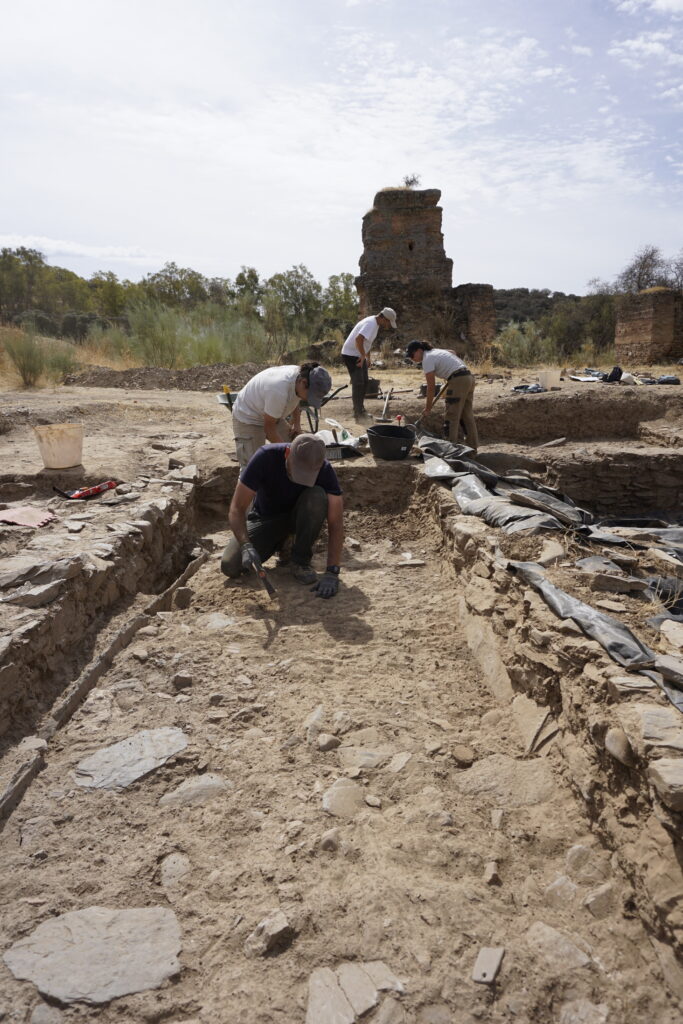
Project summary
Discovering the past through archaeology
The project is grounded in an interdisciplinary approach combining archaeological fieldwork with landscape analysis, material culture and historical sources. Through systematic and ongoing research, it aims to generate high-quality scientific knowledge, contribute to the advancement of historical and archaeological research, and promote the protection and enhancement of cultural heritage.
Through systematic and continuous research, the aim is to generate quality scientific knowledge, contribute to the advancement of historical and archaeological research, and promote the protection and enhancement of cultural heritage.
2009
Excavations started
S. XII
Main period
+5
Collaborating institutions
ROMANGORDO
Interdisciplinary methodology
01 · Archaeology
Archaeology
The research analyses both inhabited spaces and productive, defensive and communication structures, integrating the material record with a historical reading of the landscape.
The interventions are aimed at documenting the sequence of occupation, the ways of life and the evolution of the settlement in relation to its environment.
02 · Methods
Methods
The project relies on an interdisciplinary methodology combining archaeological excavation, survey and stratigraphic analysis with tools such as GIS, photogrammetry and landscape analysis.
Systematic data recording and the use of archaeometric techniques allow for a comprehensive interpretation of the site within its historical and territorial context.
03 · Campaigns
Campaigns
Archaeological campaigns are organised in a planned manner with defined scientific objectives for each phase: excavations and geophysical surveys.
Each campaign includes comprehensive documentation of structures, contexts and materials, photogrammetry, followed by preliminary analysis and interpretation of the data obtained in the field.
Work phases
Planned archaeological campaigns
Each intervention in the field follows a rigorous protocol that guarantees the integrity of the data and the scientific reproducibility of the results.
— Geophysical prospecting and surface analysis prior to excavation
— Excavation by natural and artificial units
— Photogrammetric recording of structures and contexts
— Laboratory analysis and publication of results
Phases · 01 — 03
Excavation and prospecting
Archaeological excavations and prospecting work in the intervention area.
Comprehensive documentation
Documentation of structures, contexts and materials using photogrammetry, GIS and high-precision archaeological technical drawing.
Analysis and interpretation
Preliminary analysis and interpretation of the data obtained in the field, integrated with the laboratory results and written historical sources.
Notable findings
Numismatics
Almoravid coins
An exceptional numismatic set that allows the period of abandonment in the mid-12th century to be precisely established.
Urban planning
Inhabited spaces
Identification of residential areas, craft workshops and storage spaces defining the urban layout.
Material culture
Tools and leisure objects
Collection of domestic utensils, craft tools and everyday objects.
Town planning
Productive spaces
Areas for craft activities and agricultural and pastoral resource use, reflecting an active economy.
Historical landscape
Frontier commercial network
Evidence of Albalat’s integration into a commercial network connecting its territory to other productive areas.
ConservaTiOn
Exceptional contexts
The sudden abandonment after the 12th-century attack has preserved archaeological contexts of exceptional quality, unique in the region.
SPONSORING AND COLLABORATING INSTITUTIONS



Access our
scientific resources
Publications, campaign reports, materials databases, and access to the project’s open datasets.
INSTITUTIONS THAT HAVE COLLABORATED IN PREVIOUS YEARS
Project volunteers
Since 2009, hundreds of people have volunteered for the excavation campaigns at Madīnat al-Balāṭ. Their work and dedication have made it possible to bring this Andalusian city to light.